



Walking School Bus
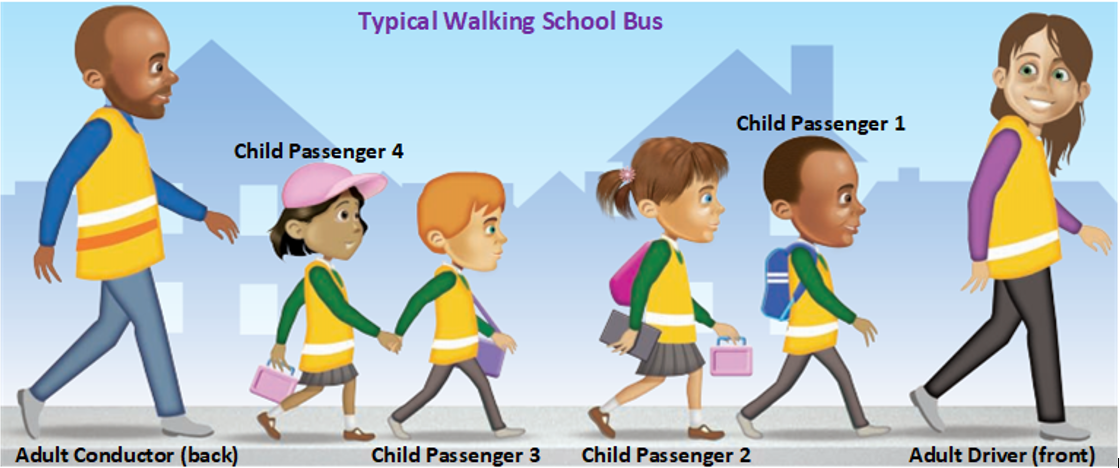
What is a walking school bus?
A walking school bus is a group of children walking to school with one or more adults. If that sounds simple, it is, and that’s part of the beauty of the walking school bus. It can be as informal as two families taking turns walking their children to school, to as structured as a route with meeting points, a timetable and a regularly rotated schedule of trained volunteers. The flexibility of the walking school bus makes it appealing to communities of all sizes with varying needs.
Parents often cite safety issues as one of the primary reasons they are reluctant to allow their children to walk to school. Providing adult supervision may help reduce those worries for families who live within walking or bicycling distance to school.
Why develop a walking school bus?
Studies show that fewer children are walking and biking to school, and more children are at risk of becoming overweight. Many schools are also seeing an increase in student absences. This can be due to students not feeling safe walking alone or not wanting to go to school, etc. Changing the behaviors of children and parents require creative solutions that are safe and fun. Implementing a walking school bus can be both and can also have the added bonus in reducing student absences, by providing a safe means of transport to school.
Benefits:
A walking school bus offers many benefits to different community members. Below are some of the possible ways that children, adults, the school and the broader community can all benefit:
- Children
- Have fun.
- Learn pedestrian safety with adult guidance and supervision.
- Participate in physical activity as part of their day.
- Foster healthy habits that could last a lifetime.
- Learn more about their neighborhoods.
- Socialize with friends and get to know children of other ages.
- Gain a sense of independence.
- Have a safe means of transportation to school.
- Arrive at school alert and ready to learn.
- Parents
- Meet other families.
- Have concerns addressed which may have kept them from allowing their children to walk to school (such as traffic, personal safety or distance).
- Save gas required to drive to and from school.
- Save time as they do not have to walk/drive their children to School.
- Schools
- #1 reason - reduces traffic congestion around schools.
- #2 reason - address reduced or lack of bus service.
- Have students who arrive on time and alert.
- Reduces absenteeism
- All community members
- Travel with fewer cars on the road.
- Live with less air pollution.
- Gain a sense of community.
- Learn that walking is a viable transportation option.
If you would like to learn more about the walking school bus in your neighborhood, please contact your school administrator.
Additional information on walking school bus code of conduct for students, rules and responsibilities, walking through the seasons, etc. can be found in the useful links below.

Please provide your question and email address in the fields below.
Your question has been successfully submitted.
CloseThank you.